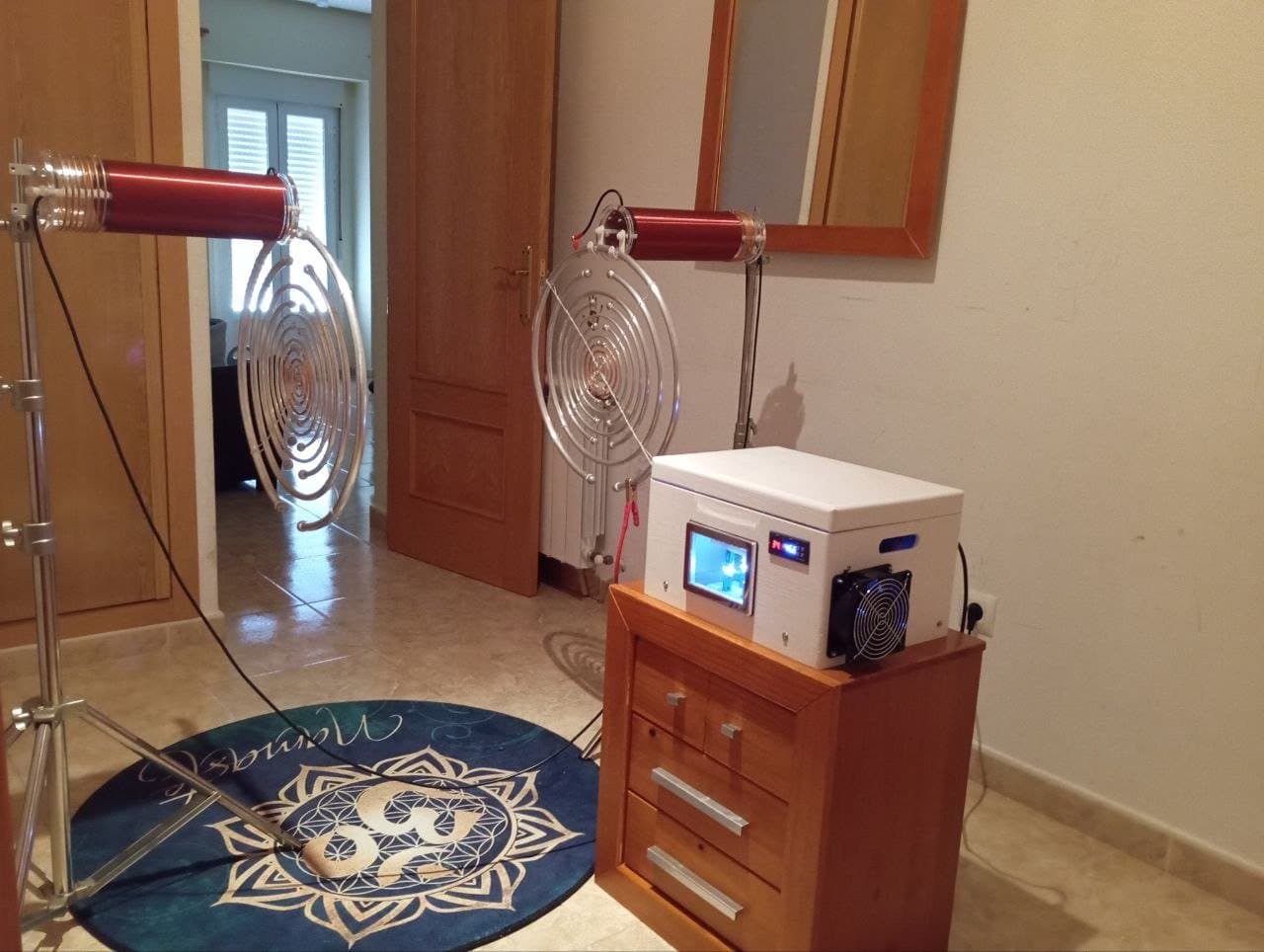
To prevent dying cells from triggering serious disorders in the body — cancer in particular — Georges Lakhovsky sought a way to artificially deliver an oscillatory impulse to every living cell, allowing each one to find its appropriate frequency within a specially generated field of waves. Given that the human body contains approximately 200 quintillion cells, each oscillating at its own unique frequency, the challenge seemed insurmountable. It was difficult to imagine a single device capable of producing every necessary frequency simultaneously. Lakhovsky solved this problem by inventing the Multiple Wave Oscillator (MWO), a device that generates a broad electromagnetic field rich in multiple frequencies, within which each cell can naturally find and lock onto its own optimal oscillation. Using the device is remarkably straightforward: with the oscillator connected to a power source, the patient is positioned — either standing or seated — between two antennas, each placed approximately 50 centimeters from the body.
Who Was Georges Lakhovsky, and What Inspired His Discovery?
Georges Lakhovsky (1868–1942) was a Russian-French engineer and researcher with a deep fascination for electromagnetic waves and their effects on living organisms. In the early twentieth century — a period of intense scientific excitement surrounding radio waves, X-rays, and high-frequency currents — Lakhovsky proposed a bold theory: every living cell vibrates at its own natural frequency, and if that optimal oscillation can be restored, the cell may remain healthy and resist the degeneration that leads to serious illness, including cancer.
In 1935, he published The Secret of Life, documenting his experiments and the construction of a device capable of emitting a wide spectrum of simultaneous frequencies. Although his work fell into near obscurity after his death, it has experienced a significant revival in recent decades within the field of bioelectromagnetism — a discipline that investigates how electrical and magnetic signals interact with biological systems.
How Does the Multiple Wave Oscillator (MWO) Work?
- Core Principle: The MWO delivers an artificial "oscillatory impulse" to the body. Rather than emitting a single frequency, it produces a broad spectrum of hundreds of thousands of simultaneous frequencies, creating an electromagnetic field dense with harmonic resonance.
- The Challenge of 200 Quintillion Cells: The human body is composed of approximately 2 × 10²³ cells, each tuned to its own natural frequency. A single-frequency device would inevitably leave the vast majority of cells out of resonance. Lakhovsky overcame this by designing a system of coupled resonators — concentric antennas powered by a standard electrical source — capable of generating a continuous frequency spectrum ranging from tens of kilohertz to several megahertz.
- The Key Innovation: By interlinking resonators of varying diameters and spacings, the MWO simultaneously emits all the wavelengths required for cellular resonance. Each cell can find its own natural "note" without any manual frequency tuning — a feat that was truly remarkable given the technology available in Lakhovsky's era.
References
- Lakhovsky, Georges. The Secret of Life. Macoy Publishing, 1935. Available at Archive.org: https://archive.org/details/TheSecretOfLife
- Šinko, Marina; Guček, Marjan. "Bioelectromagnetism: Basic Aspects and Therapeutic Applications." Electromagnetic Biology and Medicine, 29(3), 168–186 (2010). https://doi.org/10.3109/15368378.2010.495774
- Marino, A.A. Bioelectromagnetism: Current Concepts. Critical Reviews in Biomedical Engineering, 34(4), 347–416 (2006).