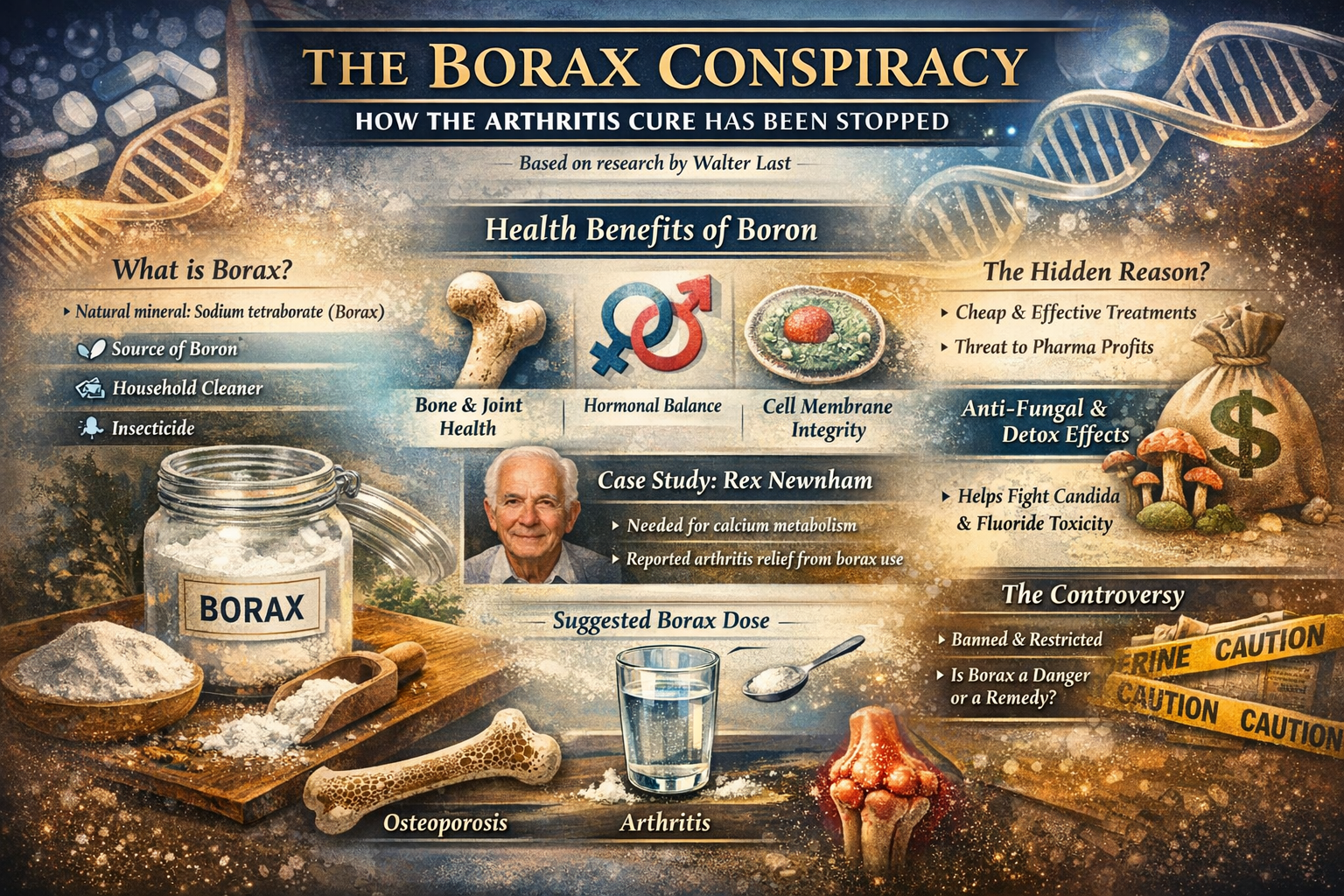
The "Borax Conspiracy": How a Potential Arthritis Cure May Have Been Suppressed
Based on the work of Walter Last, reorganized and clarified without altering its original meaning.
1. What Is Borax?
Borax is a naturally occurring mineral mined primarily from ancient dried salt lakes. Its most common chemical name is sodium tetraborate decahydrate, also known as sodium borate. Its key element of interest is boron.
According to the source text, there is no meaningful difference between "synthetic" and natural borax — the main variation lies in the amount of water of crystallization it contains. The author also argues that commercial, technical, and agricultural-grade borax typically has very high purity, and that any impurities present are common minerals rather than toxic heavy metals.
The author further explains that borax is the sodium salt of a weak acid — boric acid — and that once ingested, it can be partially converted to boric acid through reaction with stomach hydrochloric acid. Boron compounds absorbed by the body are reportedly excreted rapidly through urine.
2. The Central Argument: Boron as an Essential Nutrient
The article's core thesis is that, despite conventional medicine's long-standing uncertainty about whether boron is essential for humans, the body does in fact require it.
The argument unfolds as follows:
- •Boron is naturally present in plants and unprocessed foods.
- •This abundance made it historically difficult to detect boron deficiency through controlled experiments.
- •However, modern agriculture, chemical fertilizers, industrial food processing, and certain dietary habits have significantly reduced boron levels in the food supply.
- •As a result, boron deficiency is now far more widespread than officially recognized.
The author links this supposed deficiency to a range of health problems — particularly those involving bones, joints, mineral metabolism, hormones, and cell membranes.
3. Attributed Effects of Boron in the Body
The text attributes a wide range of physiological functions to boron and, by extension, to borax and boric acid.
a) Bones, Teeth, and Joints
According to the article, boron is essential for:
- •the structural integrity of bones and teeth,
- •the balance between calcium, magnesium, and phosphorus,
- •proper parathyroid gland function,
- •and healthy joint maintenance.
The argument is that without sufficient boron, the parathyroid glands become overactive and mobilize excessive calcium from bones and teeth into the bloodstream and soft tissues. The author suggests this process contributes to:
- •arthritis,
- •osteoporosis,
- •tooth decay,
- •calcification of soft tissues,
- •muscle stiffness,
- •arteriosclerosis,
- •kidney stones,
- •and progressive age-related deterioration.
b) Sex Hormones and Vitamin D
The text argues that boron plays a role in hormonal metabolism, particularly influencing:
- •testosterone,
- •estrogens,
- •and the activation of vitamin D.
Within this framework, boron is said to help direct calcium to where it belongs — bones and teeth — rather than allowing it to accumulate in soft tissues.
c) Cell Membranes and Broader Protective Effects
The author emphasizes that boron is important for cell membrane integrity and signal transmission across membranes. From this foundation, he extends its potential benefits to cognitive function, balance, vision, skin health, inflammation, and even certain tumor-related processes.
4. The Most Significant Claim: Rex Newnham's Arthritis "Cure"
A central section of the article is devoted to the work of Rex Newnham, an Australian scientist who, according to this account, developed arthritis and began investigating the role of boron in plant biology and calcium metabolism.
What the Text Claims
According to the article:
- •Newnham began taking borax himself.
- •Within approximately three weeks, his pain, stiffness, and inflammation reportedly resolved.
- •After observing improvements in others, he developed tablets containing a controlled amount of borax.
- •The product spread widely through word of mouth.
- •When a pharmaceutical company became involved, the initiative was allegedly blocked.
- •The author claims that Australia subsequently classified boron and its compounds as "poisons" at any concentration, effectively halting their therapeutic use.
Referenced Clinical Trial
The text also cites a double-blind trial conducted at the Royal Melbourne Hospital, claiming that:
- •70% of participants who completed the study showed significant improvement,
- •compared to just 12% in the placebo group,
- •with no notable adverse effects reported.
Geographic Correlation with Arthritis Rates
The article compares regions with varying boron levels in soil and water, suggesting that:
- •areas with lower boron levels tend to have higher rates of arthritis,
- •while areas with higher boron levels show lower arthritis prevalence.
It also claims that arthritic joints have been found to contain lower boron levels than healthy joints, and that boron supplementation may improve bone density and fracture recovery.

5. Arthritis, Osteoporosis, and Hormones
The text frames three phenomena within a single unified model:
- bone loss,
- hormonal disruption,
- impaired calcium and magnesium metabolism.
According to this thesis, boron deficiency increases urinary loss of calcium and magnesium, thereby weakening bones and teeth. The author goes so far as to present this deficiency as one of the primary drivers of osteoporosis.
He also cites animal studies and observations involving postmenopausal women and young men to support the claim that boron can raise estradiol or testosterone under specific conditions. Along these lines, he suggests potential benefits for bone mass, energy, memory, cognition, and prostate health.
6. Borax Against Fungi, Candida, and Fluoride
Another major theme in the text is that borax and boric acid possess strong:
- •antifungal,
- •antiseptic,
- •antiviral properties,
- •and the ability to disrupt biofilms and invasive forms of Candida.
The author presents testimonials and references that, in his view, demonstrate the usefulness of borax in treating:
- •candidiasis,
- •athlete's foot,
- •vaginal yeast infections,
- •and other conditions involving fungi or mycoplasmas.
He also argues that borax may help eliminate fluoride from the body by forming compounds that are excreted through urine, citing a Chinese study on skeletal fluorosis as supporting evidence.
7. Calcium–Magnesium Metabolism
The article offers an extended physiological explanation of the calcium–magnesium balance.
The reasoning is as follows:
- •calcium promotes contraction,
- •magnesium promotes relaxation,
- •when cells are low in energy or functioning poorly, calcium tends to enter and remain inside them,
- •this contributes to stiffness, spasms, poor circulation, nervous system disorders, and tissue calcification,
- •and boron acts as a regulator, preventing calcium from depositing in the wrong places while allowing magnesium to perform its proper function.
From this, the author argues that in older individuals or those with calcification, optimizing boron and magnesium intake is more important than increasing calcium.
8. Dosage and Methods of Use
The text describes the following approach:
- •A concentrated stock solution is prepared by dissolving a slightly heaped teaspoon of borax in 1 liter of water.
- •A standard dose consists of 1 teaspoon of this stock solution, equivalent to approximately 25–30 mg of borax and roughly 3 mg of elemental boron.
- •This dose may be taken once or twice daily, mixed with food or drink, and in some cases more frequently.
For protocols targeting Candida, fungi, mycoplasmas, or fluoride, the text describes higher amounts divided throughout the day, typically taken 4 to 5 days per week. Topical applications are also described, such as for athlete's foot or vaginal candidiasis.
9. Initial Reactions and "Side Effects"
The article does not frame initial adverse reactions as straightforward toxicity. Instead, it often characterizes them as "healing reactions."
Those mentioned include:
- •Herxheimer reaction,
- •temporary increase in pain,
- •discomfort from calcium mobilization,
- •sensations of stiffness,
- •tingling or numbness,
- •and temporary kidney discomfort due to increased excretion of calcium or fluoride.
The text recommends reducing or temporarily stopping intake if bothersome effects occur, then gradually reintroducing borax.
10. The Toxicity Debate
This section of the article attempts to challenge the perception that borax is highly dangerous.
The Author's Position
The author compares borax to common substances, including table salt, to argue that:
- •borax has low acute oral toxicity,
- •official safety concerns focus primarily on reproductive toxicity observed in animals at high doses,
- •and even those doses far exceed typical human exposure levels.
He also reviews data on accidental boric acid poisonings, noting that many cases produced no serious symptoms — while acknowledging that at sufficiently high doses, gastrointestinal, neurological, dermal, cardiovascular, and renal effects can occur, particularly in children and with prolonged high exposure.
The Core Argument
The author's central point is that the risks used to justify banning or restricting borax are based primarily on high-dose animal studies, not on demonstrated harm in humans under ordinary conditions of use.
11. "The Attack on Borax": The Political and Economic Thesis
The most ideologically charged section of the article argues that borax has been marginalized not because it is ineffective, but because it is too inexpensive, too accessible, and potentially threatening to certain economic interests.
The author's thesis can be summarized as follows:
- •arthritis and osteoporosis generate enormous revenue for the medical-pharmaceutical system;
- •if an inexpensive boron- and magnesium-based solution were widely adopted, that revenue stream would be threatened;
- •therefore, there has been a deliberate effort to discredit, restrict, or eliminate public access to borax;
- •the European classification of borax as a reproductive toxin and its removal from consumer markets are presented as part of this process.
The text also criticizes the fact that other household products considered potentially more toxic remain freely available while borax faces increasing restrictions.
12. Conclusion
The document's core message is clear:
- •Boron is an undervalued but essential element for human health.
- •Borax is an inexpensive, natural, and effective way to supply it.
- •It may offer broad benefits for arthritis, osteoporosis, fungal infections, mineral balance, hormone regulation, and fluoride elimination.
- •Its regulatory suppression, according to the author, is driven not purely by science, but also by economic and political interests.
The text itself concludes by acknowledging that not every chronic condition can be explained by boron deficiency alone, and that many diseases involve additional factors — nutritional deficiencies, inflammation, allergies, microbial imbalances, or other systemic disruptions.
Original References
The following sources appear in the original text, preserved in their original form:
- http://www.ncbi.nlm.nih.gov/pubmed/9838608
- http://www.whale.to/w/boron.html
- http://www.ncbi.nlm.nih.gov/pmc/articles/PMC1566647/pdf/envhper00403-0008.pdf
- http://nah.sagepub.com/content/8/2/89.full.pdf
- http://www.arthritistrust.org/Articles/Boron_and_Arthritis.pdf
- http://www.ncbi.nlm.nih.gov/pubmed/172451249
- http://www.ithyroid.com/boron.htm
- http://www.ncbi.nlm.nih.gov/pubmed/21129941
- http://www.lef.org/magazine/mag2006/aug2006_aas_01.htm
- http://www.earthclinic.com/Remedies/borax.html
- http://jac.oxfordjournals.org/content/63/2/325.long
- http://www.ncbi.nlm.nih.gov/pubmed/21774671
- http://www.ncbi.nlm.nih.gov/pmc/articles/PMC2873898/
- http://www.earthclinic.com/CURES/fluoride.html
- http://www.supergenial.ch/pi1/pdf2.html
- http://www.health-science-spirit.com/ultimatecleanse.html
- http://www.sciencelab.com/msds.php?msdsId=9927533
- http://www.hillbrothers.com/msds/pdf/n/borax-decahydrate.pdf
- http://www.atsdr.cdc.gov/toxprofiles/tp26-c2.pdf
- http://www.regulations.gov/#!documentDetail;D=EPA-HQ-OPP-2005-0062-0004
- http://en.wikipedia.org/wiki/Globally_Harmonized_System_of_Classification_and_Labelling_of_Chemicals
- http://echa.europa.eu/documents/10162/17230/supdoc_boric_acid_20100509_en.pdf
- http://www.inchem.org/documents/sids/sids/15630894.pdf
- http://www.sciencelab.com/msds.php?msdsId=9927258
Source: Base document reorganized from the original text.