For years, gender dysphoria has been framed as a purely psychological, social, or cultural phenomenon.
However, the scientific literature has long been pointing to the existence of objective biological markers in many cases — markers that deserve far more serious examination. One of the most striking findings comes from a study published in Genes & Genomics, which analyzed the karyotypes of 717 individuals with gender dysphoria seen at gender identity units in Barcelona and Málaga between 2000 and 2016. That study found an incidence of cytogenetic abnormalities more than 210% higher than that reported for the general population. (PubMed)
Notably, both transgender women and transgender men in the study group presented some form of chromosomal abnormality. (PubMed)
Klinefelter syndrome is not a minor detail. It is a sex chromosome aneuploidy — research suggests the chromosomal alteration may be linked to environmental toxins and deficiencies in minerals and hormones — typically presenting with a 47,XXY karyotype. Clinical guidelines and reviews consistently describe it as the most common sex chromosome abnormality in males, associated with hypogonadism, infertility, endocrine disruptions, and a highly variable phenotype. (Wiley Online Library)
Beyond conventional G-banding karyotyping, the Spanish study also performed high-resolution microarrays on a subsample of 23 individuals. This analysis detected a microduplication at 17q21.31, affecting the KANSL1 gene, in 7 of the 23 cases examined. The authors noted that this region had previously been described as a polymorphic and unstable — though not necessarily pathogenic — region in the general population, which calls for careful interpretation: the finding is significant, but it does not automatically imply causality. (PubMed)
What this study does allow us to conclude is that, within this cohort, there was a clear overrepresentation of chromosomal abnormalities compared to the general population. This raises a legitimate biological question: to what extent might some cases of gender dysphoria be related — at least in part — to chromosomal, endocrine, or sexual development variations? That is a serious scientific question, not a matter of opinion. (PubMed)
If we want to speak honestly, the right message is neither to trivialize these findings nor to weaponize them for ideological purposes in either direction. The right message is this: there are biological data that demand further investigation. Objective chromosomal abnormalities have been detected in certain cohorts, and reducing the entire phenomenon to a purely cultural or purely psychological explanation is scientifically inadequate. (PubMed)
It is also worth remembering that sex chromosome abnormalities are not a marginal rarity. Klinefelter syndrome is widely recognized, yet remains significantly underdiagnosed. Recent reviews continue to describe it as a common but frequently undetected condition, precisely because its clinical expression can vary so widely. This means that part of the problem may have always been present — simply understudied, misinterpreted, or rendered invisible. (NCBI)

Any serious debate about sexual identity, human development, and public health must therefore confront at least three uncomfortable truths. First: real, documented chromosomal abnormalities exist in a portion of this population. Second: these abnormalities may carry endocrine, gonadal, neurological, and reproductive implications. Third: we do not yet have sufficient scientific evidence to elevate an association into a single causal theory — much less to conclude that deliberate manipulation of the human species is at play. (PubMed)
The central question, then, is not whether to deny the biological dimension, but whether we will continue to look away when inconvenient data emerge. Honest science does not suppress findings because they disrupt a prevailing narrative. It examines them, replicates them, subjects them to rigorous critique, and — if they hold up — integrates them. That is precisely what should happen here.
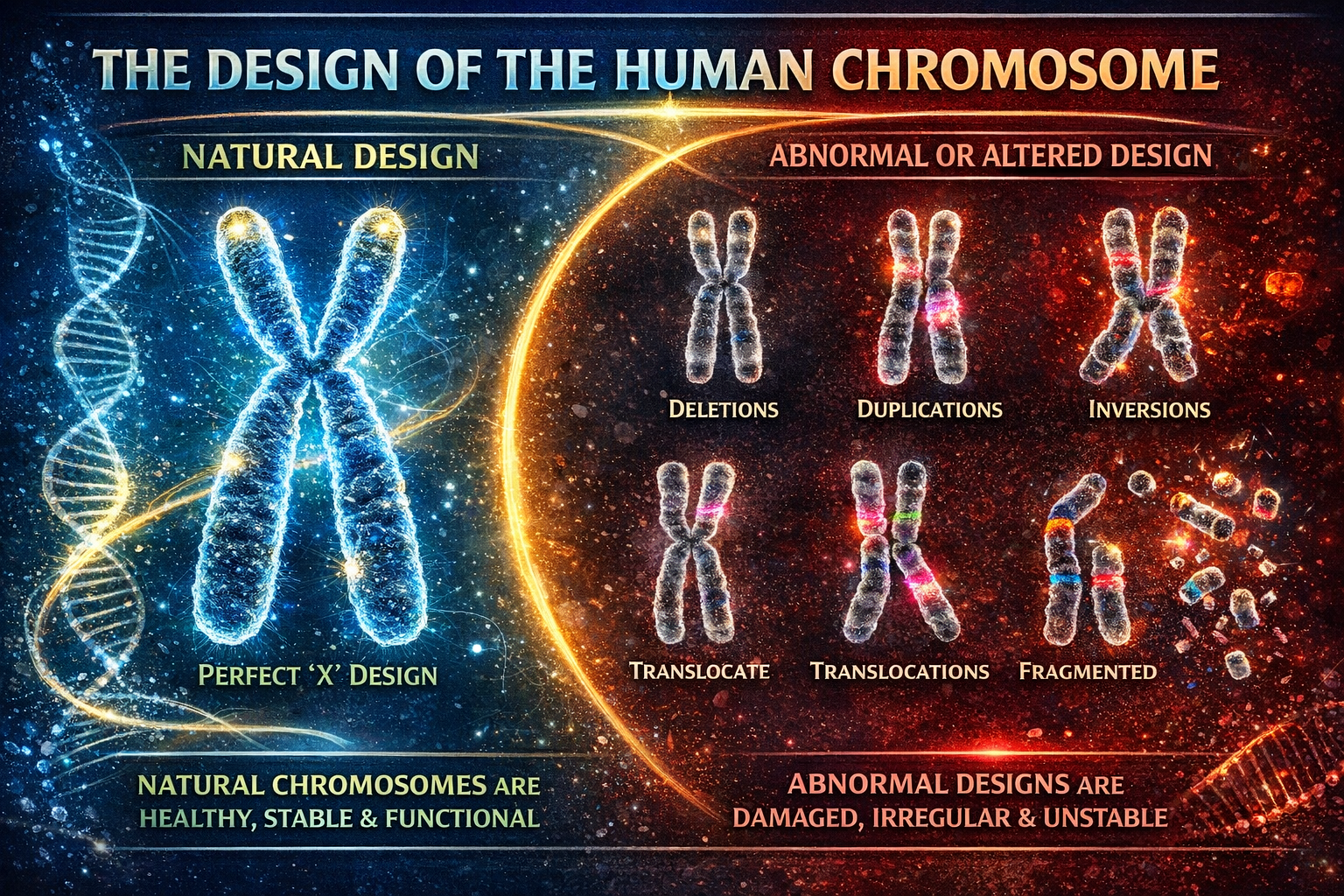
The chromosome represents the perfect geometry of the human being. Any disruption to its stability, compaction, and architecture affects not only physical health, but the overall coherence of the biological system. Science recognizes that chromosomal order is essential to the integrity of life. What some interpret as a loss of human potential must, at minimum, be understood as a loss of genomic and chromosomal stability, regulatory precision, and biological harmony. — Lucas D'Meyeer
Primary Reference
Fernández R, Guillamón A, Gómez-Gil E, Esteva I, Almaraz MC, Cortés-Cortés J, Lamas B, Lema E, Pásaro E. Analyses of karyotype by G-banding and high-resolution microarrays in a gender dysphoria population. Genes & Genomics. 2018;40(5):465–473. doi: 10.1007/s13258-017-0646-0. (PubMed)
The following image is a real photograph — not AI-generated — depicting various chromosomal deformations captured using advanced cutting-edge microscopy techniques. Chromosomes, which carry our genetic information, can undergo a range of structural alterations due to factors such as genetic mutations associated with mineral and vitamin deficiencies, high levels of environmental toxins, and exposure to harmful radiation. This image was meticulously captured in a specialized laboratory, reflecting a genuine commitment to understanding these structural variations. The unique shapes and colors visible in the photograph offer a window into the complex biological processes underlying life itself, providing clues about how certain conditions manifest — and how chromosomal anomalies might be corrected to improve human health.